Ghosts in the Platter: The Science and Ethics of Magnetic Media Forensics
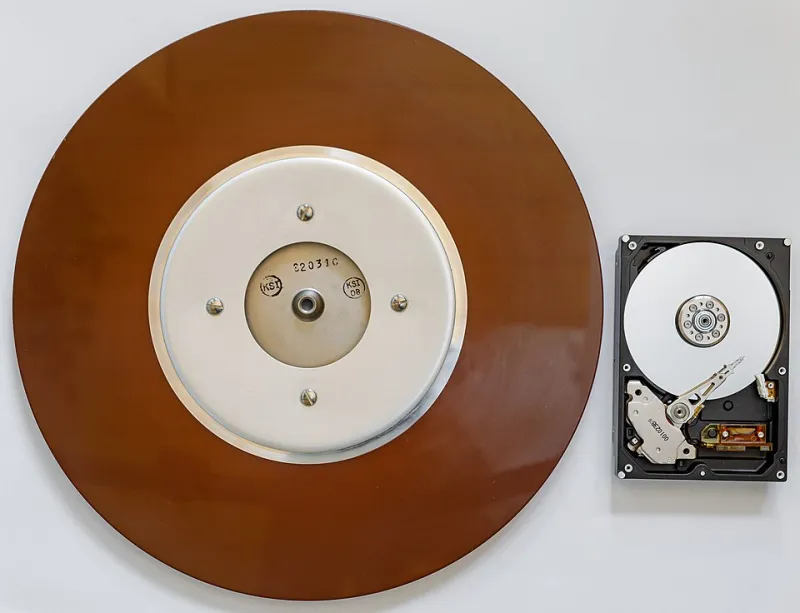
Photo: Friedrich Haag, CC BY-SA 4.0, via Wikimedia Commons
A hard drive arrives in a laboratory sealed inside an antistatic bag. Its casing is warped from heat. The actuator arm has seized. By any ordinary measure, the device is dead. Yet inside that blackened aluminum shell, invisible magnetic domains still cling to the surface of the platters, each one a fragment of a record that someone — an investigator, a historian, a grieving family member — desperately needs to read.
This is the daily reality for the specialists who practice magnetic media forensics, a discipline that sits at the intersection of materials science, digital investigation, and legal procedure. Their tools range from cleanroom workbenches and electron microscopes to proprietary firmware patches and custom-built platter readers. Their subjects are drives that have survived floods, fires, deliberate destruction, and decades of neglect. And their findings have, on more than a few occasions, changed the outcome of federal investigations, corporate litigation, and historical scholarship.
Reading the Residue
To understand how data survives apparent catastrophe, it helps to understand how magnetic storage works at its most fundamental level. Data is written to a hard drive's platters by a read/write head that generates a localized magnetic field, flipping microscopic regions of the platter's ferromagnetic coating into one of two orientations — the binary language of ones and zeros. When a file is deleted or a drive is formatted, the operating system typically removes the directory entry pointing to that data rather than overwriting the magnetic domains themselves. The ghost of the original information remains on the surface, intact and legible to the right instruments.
Even partial physical damage rarely destroys all recorded data simultaneously. A platter scratched by a crashed read/write head loses only the sectors directly beneath the impact. A drive subjected to high heat may experience demagnetization at the outermost edges of its platters while the innermost tracks survive. Flood damage, counterintuitively, poses less of a threat to the magnetic coating itself than to the drive's electronics; a platter submerged in fresh water for days can often be cleaned and read once its controller board is restored or replaced.
Forensic technicians exploit all of these characteristics. In a certified cleanroom environment — a controlled space where airborne particulates are reduced to a fraction of those found in a standard office — they disassemble damaged drives and transplant platters into functioning donor mechanisms. When the physical media is too compromised for conventional reading, some laboratories employ magnetic force microscopy, a technique borrowed from materials science that maps the magnetic state of individual domains at nanometer resolution. Others use specialized firmware commands to instruct a drive's own read/write heads to report raw magnetic flux data rather than interpreted binary values, allowing analysts to reconstruct sectors that the drive's onboard logic would otherwise flag as unreadable.
Cases That Defined the Field
The courtroom applications of magnetic media forensics first gained widespread public attention during the corporate fraud investigations of the early 2000s. In several high-profile accounting scandals, defendants had attempted to destroy incriminating financial records by degaussing hard drives — exposing them to a powerful alternating magnetic field designed to randomize their stored data. Forensic analysts discovered that consumer-grade degaussers, applied hastily and inconsistently, often failed to fully neutralize drives with high-coercivity platters. Partial records survived, and those fragments proved sufficient to establish document trails that prosecutors had believed were permanently lost.
In one federal civil case widely discussed among digital forensics practitioners, a recovered drive yielded emails whose sent timestamps contradicted sworn testimony about the timing of key business decisions. The physical drive had been deliberately submerged in water before disposal. The platters, once dried and transplanted, retained enough readable data to reconstruct the correspondence. The case settled before trial, but the forensic evidence fundamentally altered the negotiating position of both parties.
Historical preservation has benefited from the same techniques, though with far less fanfare. Several university archives and independent research institutions have employed data recovery specialists to extract material from drives donated alongside the papers of deceased scholars, engineers, and journalists. In at least one documented case, a collection of interview recordings made by a technology journalist in the 1980s — believed lost when the journalist's estate discarded aging equipment — was partially recovered from a mechanically failed drive. The recordings contained candid conversations with engineers who had since died, offering accounts of early personal computing development that existed nowhere else in the historical record.
The Limits of Recovery
Forensic specialists are careful to distinguish between what is theoretically possible and what is practically achievable. A platter that has been physically shattered into fragments, subjected to sustained extreme heat, or processed through an industrial shredder presents challenges that current technology cannot reliably overcome. Secure data destruction standards maintained by the federal government specify overwrite procedures and physical destruction methods precisely because magnetic residue is so persistent under ordinary conditions.
The field also confronts a growing technical challenge in the form of drive density. Modern hard drives pack data so tightly — with individual magnetic domains measured in nanometers — that the signal-to-noise ratio for forensic reading becomes significantly less favorable than it was with drives manufactured a decade or two ago. Techniques that worked reliably on drives from the 1990s and early 2000s are less consistently effective on contemporary high-density media. Some practitioners argue that the most forensically accessible era of magnetic storage may already be behind us.
Ethical Dimensions
The power to recover data that individuals believed destroyed raises serious ethical questions that the forensic community continues to debate. Privacy advocates have long argued that citizens possess a legitimate expectation that discarded or formatted media will not yield recoverable personal information to unauthorized parties. The same capabilities that allow investigators to recover evidence of corporate fraud can, in principle, be applied to extract private medical records, personal communications, or financial information from drives that passed through secondhand markets or recycling programs.
Reputable forensic laboratories maintain strict chain-of-custody protocols and operate only under legal authorization — court orders, contractual agreements with device owners, or documented institutional mandates. The field's professional organizations have developed ethical guidelines that mirror those governing other forensic disciplines. But the barrier to entry for basic data recovery has fallen considerably as commercial recovery software has become widely available, and the ethical framework has not always kept pace with the technology's accessibility.
For historians and archivists, the ethical calculus carries additional complexity. A drive recovered from an estate may contain both irreplaceable historical documentation and deeply personal material that the original owner never intended for any audience. Decisions about what to preserve, what to restrict, and what to permanently delete require judgment that goes beyond technical expertise.
Preservation as Imperative
At the Magnetic Disk Heritage Center, we observe this field with particular attention because it illuminates something essential about the nature of magnetic storage: the medium is simultaneously more fragile and more durable than it appears. Drives fail catastrophically and without warning. They also retain their secrets with remarkable tenacity, yielding them only to those with the patience, the tools, and the expertise to ask correctly.
The history encoded on aging magnetic media — the correspondence of engineers, the financial records of defunct companies, the working files of artists and scholars — is not simply lost when a drive stops spinning. It persists in a liminal state, accessible in principle, recoverable in practice, and worth the considerable effort required to retrieve it. The specialists who do this work are, in a meaningful sense, archaeologists of the recent past, and the platters they read are primary sources in the history of how we lived and worked in the digital age.