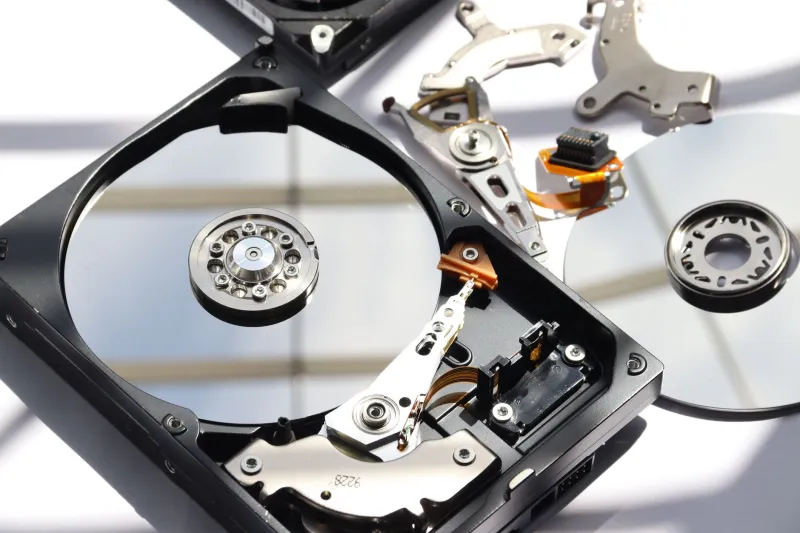
Reading the Unreadable: How Specialists Recover Corporate History From Damaged Magnetic Platters
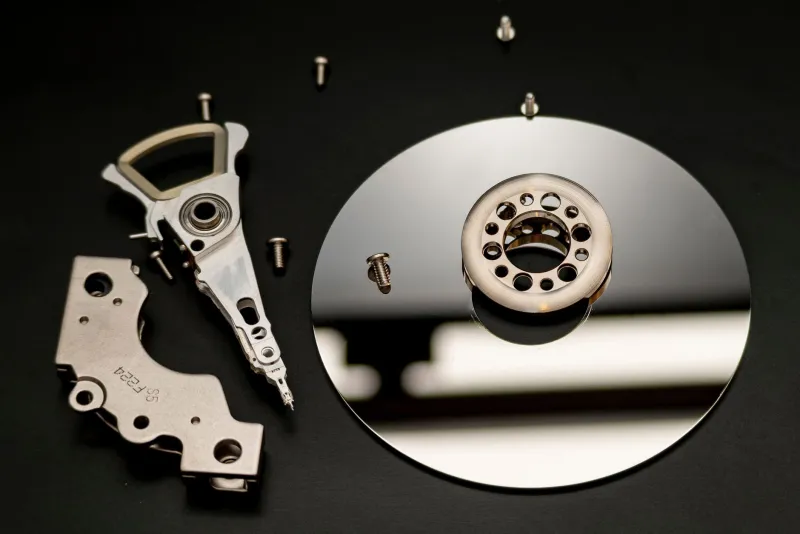
The aluminum platter removed from a 1987 IBM hard drive looks, at first glance, like a ruin. Its magnetic oxide coating has partially delaminated along one quadrant. Corrosion has crept inward from the spindle hub. Under fluorescent light, the surface exhibits the dull, uneven sheen of a material that has been failing for decades in a basement storage room somewhere in the American Midwest. To most observers, it represents a dead end. To a trained platter analyst, it represents a puzzle with a recoverable answer.
This is the daily reality for the specialists who occupy a narrow but consequential corner of archival practice — professionals who have developed methods for extracting meaningful data from magnetic disk surfaces that standard recovery software cannot touch. Their techniques draw on an understanding of how magnetic media was manufactured, how it degrades over time, and how the physical and chemical properties of a platter's coating interact with the information encoded upon it. The work is painstaking, frequently expensive, and occasionally miraculous.
Why Business Records Are Especially Vulnerable
Corporate and institutional archives present a particular challenge for digital preservation. Unlike government records, which often benefit from formal retention mandates and dedicated archival infrastructure, business records have historically been stored opportunistically — on whatever media was available, in whatever conditions a given organization happened to maintain. Throughout the 1970s, 1980s, and 1990s, magnetic disk storage was the default medium for active business data: financial ledgers, personnel files, correspondence, contract databases, engineering specifications.
When companies closed, merged, or simply reorganized their storage practices, those disks frequently ended up in off-site warehouses, filing cabinets, or cardboard boxes. Temperature fluctuations, humidity, physical shock, and the simple passage of time have taken a cumulative toll. By the time a historian or archivist attempts recovery, the media may have been sitting in suboptimal conditions for twenty or thirty years.
The problem is compounded by the diversity of disk formats and manufacturing standards across that era. A platter produced by Seagate in 1984 has a materially different oxide formulation than one produced by Maxtor in 1992. Recovery techniques that work well on one may be entirely ineffective on the other. Specialists must essentially become students of disk manufacturing history, building a working knowledge of which coatings, substrates, and binder chemistries were used by which manufacturers during which periods.
Surface Analysis: Beyond Conventional Recovery
Conventional data recovery — the kind performed by commercial services using software tools — depends on a drive being sufficiently functional to spin up, present its read heads to the platter surface, and communicate with a host system. When a platter has physically degraded past that threshold, a different approach is required.
One established technique involves the use of magnetic force microscopy, an adaptation of atomic force microscopy that maps the residual magnetic field variations across a platter surface at nanometer-scale resolution. By generating a detailed topographic and magnetic map of the disk, analysts can sometimes identify flux transitions — the fundamental units of magnetic encoding — even in areas where the oxide coating has partially deteriorated. The resulting data is noisy and incomplete, but it can be processed through probabilistic reconstruction algorithms to recover substantial portions of the original content.
Another approach, used when delamination has rendered direct surface contact impossible, involves chemical stabilization of the oxide layer before any imaging attempt is made. Conservators borrowed this technique from the paper and photographic preservation communities, adapting consolidant chemistry to the specific binding agents used in magnetic coatings. The goal is not restoration in the aesthetic sense but stabilization sufficient to permit a single imaging pass before further deterioration occurs.
In cases where the platter substrate itself has warped or fractured, some specialists have developed protocols for precision re-flattening using controlled heat and pressure — a procedure that carries significant risk of permanent data loss and is typically attempted only when all other options have been exhausted.
Case Studies in Rescued Records
The practical stakes of this work become clear when examining specific recovery cases. In one documented instance, a regional bank that had ceased operations in the early 1990s left behind a collection of hard drives containing loan origination records relevant to an ongoing legal dispute over property rights. The drives had been stored in a non-climate-controlled facility for over two decades. Standard recovery attempts failed entirely. Surface imaging combined with algorithmic reconstruction ultimately yielded approximately sixty percent of the original data — enough to establish the evidentiary record the case required.
In another case, a manufacturing firm's engineering archive, stored on 5.25-inch hard drives from the mid-1980s, contained product specifications relevant to a product liability investigation. The drives exhibited classic stiction failure compounded by lubricant migration across the platter surface. After careful cleaning and head replacement, combined with sector-by-sector imaging under controlled atmospheric conditions, analysts recovered the majority of the specification files — records that had not existed in any other format.
Perhaps most poignant from a historical preservation standpoint are recoveries undertaken not for litigation but for institutional memory. Several universities and historical societies have commissioned platter analysis on drives recovered from defunct regional businesses, recovering payroll records, internal communications, and operational data that provide granular documentation of mid-century American commercial life. These records, invisible to conventional archives, offer perspectives on labor practices, supply chain relationships, and organizational culture that no printed document preserved.
The Physics of Memory
Underlying all of these techniques is a fundamental insight: magnetic encoding is a physical phenomenon, and physical phenomena leave traces even when the systems designed to read them have failed. The magnetic domains written to a platter during normal operation do not simply vanish when the drive stops functioning. They persist, degraded and partially obscured by noise and physical damage, but present — waiting for a method of detection sensitive enough to find them.
This is the premise on which the entire field of advanced platter analysis rests. It is also what connects this highly technical work to the broader mission of documentary preservation. The platters that passed through American businesses during the last decades of the twentieth century are not simply failed hardware. They are records — imperfect, vulnerable, and increasingly urgent to address before further time makes recovery impossible.
An Accelerating Window
The specialists working in this field are consistent on one point: the window for recovery is narrowing. Magnetic oxide coatings continue to degrade at rates determined by their original chemistry and subsequent storage conditions. Platters that might have yielded sixty or seventy percent recovery a decade ago may yield thirty percent today. The equipment and expertise required to perform advanced surface analysis are concentrated in a small number of laboratories across the country, and the institutional funding to support systematic recovery efforts remains limited.
For organizations holding collections of legacy magnetic media — historical societies, corporate archives, university libraries — the implication is direct. Assessment and triage of existing collections, conducted now, may determine whether the business history encoded on those platters survives into the next generation of scholarship. The Magnetic Disk Heritage Center continues to document the methods, the practitioners, and the recovered records that constitute this fragile and essential form of preservation work.