Hearing the End Coming: How Specialists Learn to Read a Dying Drive Through Sound
There is a moment, familiar to anyone who has spent years working with magnetic disk storage, when a drive begins to sound subtly wrong. Not dramatically wrong — not yet — but wrong in the way that an experienced mechanic hears an engine misfiring before the dashboard light ever illuminates. The pitch shifts almost imperceptibly. A rhythmic pattern acquires a faint irregularity. A seek operation that should resolve cleanly instead carries a trailing resonance, like a tuning fork struck slightly off-center. For most users, these signals pass unnoticed. For a small community of specialists, they constitute a diagnostic language — one learned not from textbooks, but from years of proximity to machines in the process of dying.
This article examines the acoustic and vibrational signatures that precede magnetic disk failure, the science that underlies them, and the human expertise that has evolved, largely outside of formal documentation, to interpret them.
The Physics of a Drive Under Stress
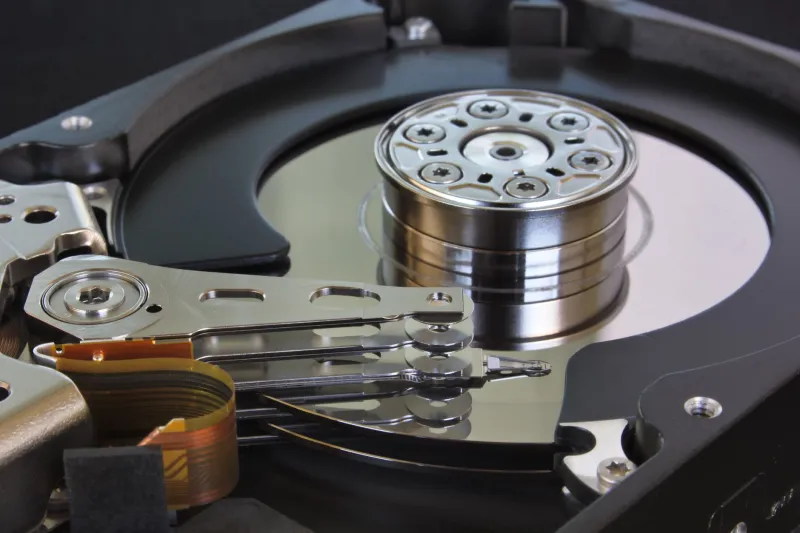
To understand why a failing hard drive sounds the way it does, it is necessary to first appreciate the extraordinary mechanical precision that governs normal operation. A contemporary magnetic hard drive — and its predecessors stretching back through decades of storage history — is among the most precisely engineered mechanical devices ever manufactured for consumer use. Read/write heads float nanometers above platters spinning at thousands of revolutions per minute, guided by actuator arms controlled through feedback loops of remarkable sensitivity. Under normal conditions, this system operates with a consistency that renders it acoustically unremarkable: a steady rotational hum, the measured sweep of head seeks, the soft percussion of head parking.
When components begin to degrade, however, that precision erodes — and the acoustic character of the drive changes with it. Bearing wear introduces subtle irregularities into the rotational profile, producing low-frequency vibration signatures that experienced technicians describe variously as a "grinding undertone" or a "roughness in the spin-up." Platter surface defects cause the read/write heads to encounter microscopic discontinuities in the magnetic medium, generating characteristic seek retries that manifest as repetitive, slightly arrhythmic clicking patterns distinct from the drive's normal seek behavior. Actuator arm instability produces what some specialists describe as a "hunting" quality — a hesitation followed by overcorrection — that is audible to trained ears as a kind of mechanical indecision.
The Vocabulary of Degradation
Among data recovery professionals, there exists an informal but surprisingly consistent vocabulary for these pre-failure acoustic signatures. Practitioners working across the United States — in facilities ranging from certified clean-room operations to independent repair shops — have independently developed terminology that reflects the same underlying physical phenomena.
"Stiction whisper" refers to the faint high-frequency scraping sound produced when a drive's heads momentarily adhere to the platter surface during spin-up, a condition that typically precedes full stiction failure by days or weeks. "Sector grief" is a colloquial term for the characteristic multi-attempt seek pattern generated when a drive repeatedly attempts to read a degrading sector, producing an acoustic signature of three to five rapid clicks followed by a brief pause. "Bearing song" describes the tonal shift in rotational hum that accompanies early-stage spindle bearing deterioration — a change often described as a slight rise in pitch accompanied by a new harmonic component.
What is notable about this vocabulary is not merely its precision but its transmission. It has been passed, largely through apprenticeship, from senior technicians to junior ones — a form of tacit knowledge that resists easy formalization. Several specialists interviewed for this article noted that written descriptions of these sounds are of limited utility; the diagnostic skill, they emphasize, is fundamentally experiential.
Between Intuition and Instrumentation
The question of whether acoustic drive diagnostics constitutes genuine science or refined intuition is one that practitioners themselves debate with some energy. The honest answer appears to be that it is both, and that the boundary between them is not always easy to locate.
On the instrumentation side, vibration analysis tools — accelerometers, spectrum analyzers, and specialized drive diagnostic software — have been used in enterprise storage environments for decades to detect anomalous mechanical signatures. Hard drive manufacturers have long incorporated Self-Monitoring, Analysis and Reporting Technology (SMART) systems that track internal operational parameters, some of which correlate with the acoustic phenomena specialists describe. Elevated reallocated sector counts, increasing seek error rates, and spin-up time anomalies are all SMART indicators that correspond to conditions that experienced technicians can sometimes detect by ear before the data surfaces in diagnostic software.
Yet the specialists themselves are often emphatic that instrumentation alone does not capture the full picture. SMART data, they note, is retrospective — it records degradation that has already occurred rather than anticipating failure trajectories. Acoustic diagnosis, practiced at a high level, involves pattern recognition across multiple simultaneous variables: not just the presence of an anomalous sound, but its character, its timing relative to specific drive operations, its evolution over successive power cycles, and its interaction with ambient temperature and load conditions. This is the kind of multi-variable synthesis that human perception, trained over years of exposure, can perform in ways that current automated systems do not reliably replicate.
A Knowledge Base at Risk of Disappearing
From the perspective of preserving the history of magnetic storage technology, the acoustic diagnostic tradition represents a form of heritage that sits in an uncomfortable position. It is neither artifact nor document — it is embodied expertise, residing in the perceptual and cognitive capacities of a relatively small number of practitioners, most of whom learned their craft during the era of mechanical hard drive dominance in personal computing.
As solid-state storage has displaced magnetic disk in an increasing share of consumer and enterprise applications, the population of technicians with deep mechanical drive experience has contracted. Training pipelines that once reliably produced new generations of specialists have narrowed. The informal apprenticeship networks through which acoustic diagnostic knowledge has historically been transmitted are under pressure.
Some within the data recovery community have begun efforts to document this knowledge more systematically — through annotated audio recordings of drive failure signatures, through structured interviews with senior practitioners, and through the development of reference libraries that can serve as training resources for the next generation. These efforts are valuable, but practitioners are candid about their limitations. A recording of a failing drive, however carefully annotated, is not a substitute for the experience of diagnosing one.
The Moral Dimension of Listening
There is, finally, a dimension of this subject that extends beyond the technical. The data stored on magnetic disks — the personal archives, the business records, the institutional histories — represents human experience rendered in physical form. When a specialist listens to a drive and identifies the early signatures of failure, they are, in a very real sense, intervening in the potential loss of that experience. The acoustic diagnostic tradition is not merely a technical skill; it is a form of stewardship.
For an institution dedicated to preserving the history of magnetic disk storage, that dimension deserves recognition alongside the engineering achievements more commonly celebrated. The machines themselves are remarkable. But the human expertise developed to understand them — to hear, in the subtleties of mechanical sound, the difference between health and impending failure — is a form of knowledge equally worthy of preservation.